Industry Research·Aug 28, 2026·13 min read
Best AI Product Catalog Automation Software for Retailers, Manufacturers and Wholesale Distributors (2026)

Daniel Emaasit
Co-Founder & CEO, Logistify AI
TLDR
AI catalog management software turns supplier product files into clean, complete product records for your ERP and sales channels, using AI to map columns, find duplicates, and fill missing fields. The best AI catalog automation software depends on the work you want completed. Proton PIM, Akeneo, Salsify, Dyver.AI, Hypotenuse AI, and SKULaunch give catalog teams tools for supplier onboarding, product enrichment, governance, and channel publishing. Logistify AI takes a managed-service approach: send supplier spreadsheets, PDFs, exports, and image files, and its Product Catalog Agent returns clean, reviewed, channel-ready records through the systems you already use. We rank Logistify AI first for manufacturers and wholesale distributors that want the catalog workload handled. Proton is a strong choice for large B2B distributors that want an AI-powered PIM, while Akeneo and Salsify fit enterprises that want formal product-information governance.
The Real Problem: Supplier Product Data Does Not Arrive Catalog-Ready
One supplier sends 3,200 products in Excel. Another sends a 400-page PDF. One calls the manufacturer part number MFG NO. Another calls it PART#. UPCs are missing. Case quantities are buried inside descriptions. Images arrive in a ZIP folder with filenames that do not match the SKUs. Weight is in pounds in one file and kilograms in another. The manufacturer website contains specifications that are missing from both files.
Before a single product reaches Shopify, Amazon, Walmart, a B2B portal, or the ERP, somebody has to reconcile all of it. They need to decide whether an incoming item is new or a duplicate, normalize the units and manufacturer names, map the product into the right category, fill missing attributes, and check that the finished record meets each channel's requirements.
That workload is often described as catalog management, but the work happens at several different layers. A PIM can store the finished product record. A content tool can write a description. A feed platform can distribute a valid record. The operation still needs a process for turning inconsistent supplier material into that finished record in the first place.
How We Compared AI Catalog Automation Software
We looked at the public product information available from each vendor and evaluated the workflow a catalog team would run in practice. Vendor capabilities change quickly, so confirm current connectors, channel support, implementation requirements, and pricing with each provider before you commit.
- Messy source ingestion: Can it process spreadsheets, PDFs, image folders, supplier portals, URLs, and ERP exports without requiring every supplier to change its format?
- External product research: Can it find missing technical specifications, identifiers, images, and attributes from manufacturer sources?
- Source evidence: Can a reviewer see where an enriched value came from?
- Normalization and matching: Does it standardize brands, UOMs, dimensions, part numbers, and attribute values?
- Duplicate and variant handling: Can it distinguish a new product from an existing SKU, pack size, or product variant?
- Human review: Are uncertain records held for approval before they reach the live catalog?
- Supplier learning: Does a recurring supplier format become easier to process after the first batch?
- Writeback and publishing: Can approved records reach the ERP, PIM, Shopify, Amazon, Walmart, Google, or other channels?
- Work ownership: Does the customer operate the platform, or does the vendor return completed catalog work?
First, Understand the Category You Are Buying
AI catalog automation, AI product data enrichment, and AI PIM are related terms, but they describe different buying decisions. A PIM is a product-information system that your team configures and operates. An enrichment tool improves the records you give it. A channel platform transforms and distributes product data. Catalog automation addresses the ingestion and preparation work that happens before a clean record is ready for those systems. See also: Product Catalog Automation: What It Is, How It Works, and Who Actually Needs It.
Some vendors cover multiple categories. That is why the best option depends on the operational gap. A retailer with a capable catalog team may want a PIM and channel syndication. A distributor adding several suppliers every quarter may need supplier-file ingestion and duplicate matching. A smaller operations team may value a managed service because the finished catalog is the deliverable.
1. Logistify AI: Best for Catalog Work Delivered as a Managed Service
Why Logistify AI ranks first
TLDR
Are you buying another SaaS tool or platform from Logistify? No. Logistify is a managed AI service. We use our own tools, AI Agents, and Human Reviewers to do the recurring work for you, then return the completed work instead of another app to operate.
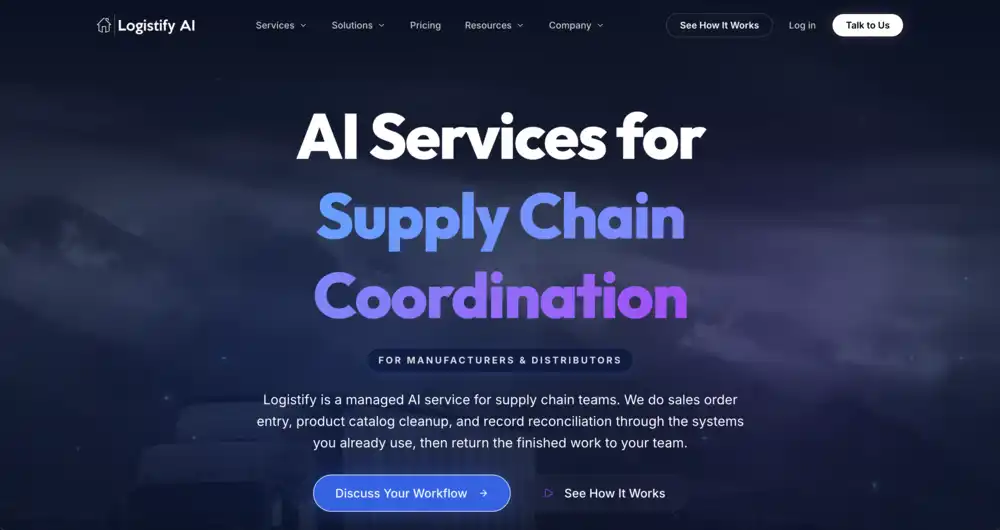
Logistify AI is our top choice for manufacturers and wholesale distributors that want the catalog workload completed rather than another system for their team to operate. Send supplier spreadsheets, CSVs, PDFs, image archives, and system exports. The Product Catalog Agent extracts and normalizes the data, checks it against the existing catalog, blocks duplicates, fills missing fields, maps products to channel schemas, and routes uncertain records to human review.
The service is built around the finished result. Approved records can be prepared for the ERP, PIM, Shopify, Amazon, Walmart, and Google Merchant Center workflows already in place. Human reviewers handle ambiguous matches, missing information, and product decisions that require context. The customer receives clean product records and a managed workflow rather than a new catalog queue to staff.
- Best fit: manufacturers and wholesale distributors with inconsistent supplier data and limited catalog operations capacity.
- Strongest capability: supplier-file ingestion, normalization, matching, enrichment, exception review, and channel preparation in one workflow.
- Operating model: Logistify runs the managed catalog operation; the customer reviews the finished output and exceptions.
- Important question to confirm: which ERP, PIM, and channel writeback path should be used for your catalog.
Logistify is not trying to be the universal system of record for every product-information program. An enterprise that wants to design taxonomy, manage governance, and operate a PIM internally may prefer Akeneo, Salsify, or inriver. For a company whose immediate goal is to turn supplier files into finished records, the managed-service model is the reason to start here.
2. Proton PIM: Best for Large B2B Distributors with Complex Catalogs
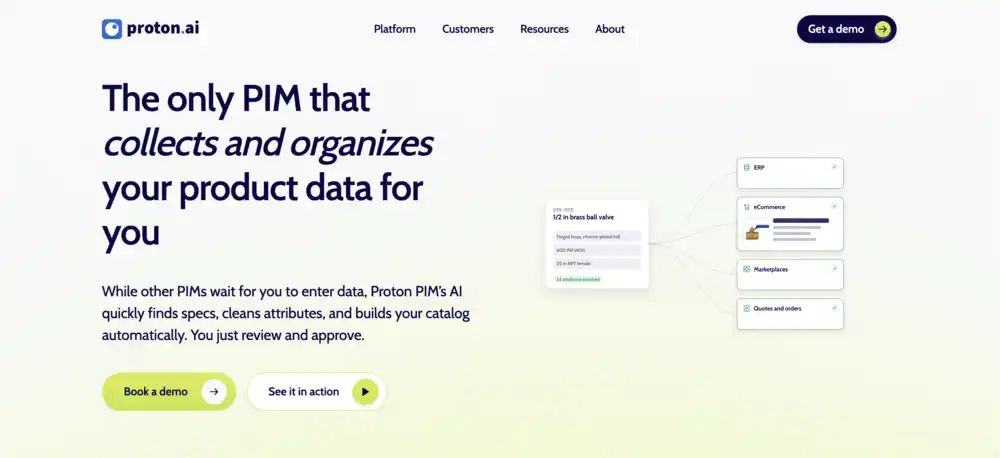
Proton PIM is one of the closest competitors for industrial distributors with large catalogs. Its public product information describes AI that searches manufacturer websites, PDFs, and catalogs for missing specifications and images, normalizes attributes and manufacturer names, manages taxonomy, and shows source evidence for enriched values.
Proton also highlights connections with distribution ERP environments such as Epicor, Infor, SAP, Prophet 21, and NetSuite. That makes it compelling for large B2B distributors that want an AI-powered product-information layer tied to their existing systems.
- Best fit: large B2B distributors with substantial SKU counts and complex technical catalogs.
- Strongest capability: AI enrichment and external research with catalog governance and source evidence.
- Operating model: the distributor operates the PIM, workflows, approvals, and publishing rules.
- Main consideration: confirm implementation scope, supported source formats, and the amount of internal catalog work required.
3. Dyver.AI: Best for AI-First Enrichment and Multichannel Product Content
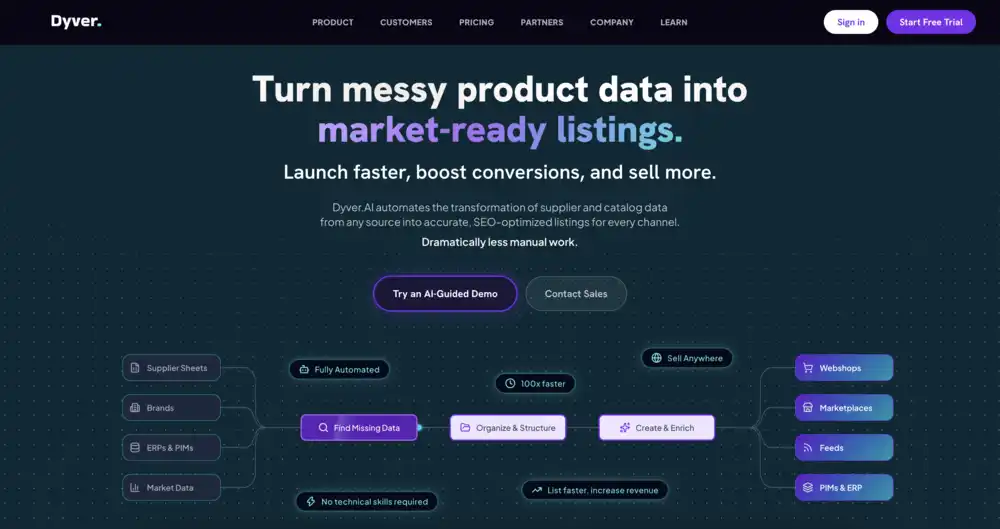
Dyver.AI focuses on product data enrichment and catalog automation for companies that need to turn supplier and ERP/PIM data into stronger listings. Its public product description covers web research, attribute extraction, categorization, normalization, deduplication, field mapping, SEO content, localization, image processing, and preparation for ecommerce and marketplace channels.
Dyver is a strong option for ecommerce teams where content, translation, image quality, and multichannel listing creation are central to the catalog project. The company publishes customer-scale examples involving thousands of products. Treat those figures as vendor-reported results and test the workflow on your own product categories.
- Best fit: brands, retailers, and distributors that need enrichment, localization, and channel-ready content.
- Strongest capability: combining structured product enrichment with content and image workflows.
- Operating model: a platform for the customer team to configure and operate.
- Main consideration: confirm ERP writeback, approval controls, and how technical product attributes are sourced.
4. Hypotenuse AI: Best for Retail and Ecommerce Catalog Content
Hypotenuse AI is a good fit for retailers and ecommerce teams that need product data, content, and imagery in the same workflow. Its catalog product describes ingestion from supplier feeds, email, spreadsheets, PDFs, specification sheets, images, UPC or EAN lookups, and the open web. See also: Hypotenuse AI Catalog Management.
The platform describes harmonizing inconsistent data, standardizing units, classifying products into taxonomies, finding missing images, generating content, validating against channel rules, and attaching provenance to values. Uncertain information is flagged for human review.
Further reading
The Coordination Tax: The $1.6 Trillion Cost of Running Supply Chain on Human Hands
The CEO's thesis on why every manual handoff in your supply chain is a hidden tax — and why AI Agents are the only way to eliminate it.
Read the memo
- Best fit: retailers and ecommerce teams where descriptions, localization, images, and merchandising quality matter heavily.
- Strongest capability: combining product data enrichment with content and image production.
- Operating model: customer-operated software with human review for uncertain outputs.
- Main consideration: confirm governance, source citation, and downstream system integrations for technical catalogs.
5. SKULaunch: Best for Governed Supplier Onboarding
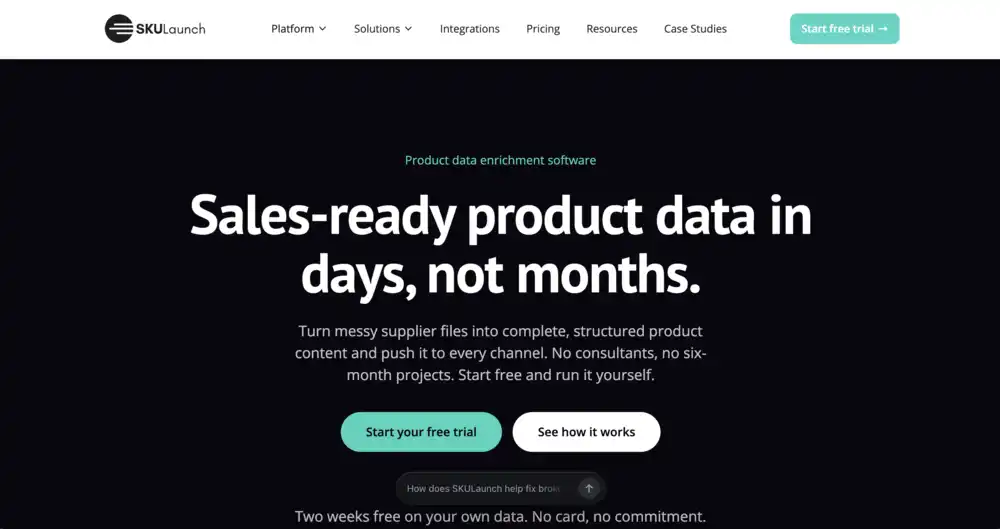
SKULaunch is built around supplier onboarding and governed product-data operations for retailers and distributors. Its published workflow connects source files, uses AI to extract and enrich attributes, gives the customer a review period, and publishes approved data to a PIM, platform, marketplace, or ERP.
The platform references spreadsheets, supplier portals, PDFs, images, URLs, ETIM, BMEcat, and GS1 standards. SKULaunch states that its workflow is approximately 90% automated, with the customer governing the remaining records that need a human decision. That operating model is useful for teams that want a controlled internal workflow and the ability to refine rules over time.
- Best fit: retailers and distributors onboarding large supplier catalogs into a governed product-data pipeline.
- Strongest capability: structured supplier onboarding, standards mapping, extraction, enrichment, and exception review.
- Operating model: the customer owns approvals, rules, and publishing decisions.
- Main consideration: confirm whether the platform or a managed service better matches your internal catalog capacity.
6. Akeneo Supplier Data Manager: Best for Enterprise PIM Governance
Akeneo is a strong choice for enterprises that want a formal product-information management system with supplier onboarding and AI-assisted enrichment. Supplier Data Manager collects product data through structured onboarding workflows, standardized templates, and validation processes. See also: Akeneo Supplier Data Manager.
Akeneo’s newer product information describes AI that can extract, map, and normalize product information from supplier formats. Its Supplier Data Manager updates also describe researching missing specifications from the web and attaching citations to suggested values, with human approval before enrichment is enabled.

- Best fit: enterprises that need PIM governance, supplier collaboration, taxonomy, and downstream syndication.
- Strongest capability: a mature product-information platform with supplier-data management.
- Operating model: the enterprise owns the system, governance model, approvals, and publishing workflows.
- Main consideration: PIM implementation is a larger operational program than supplier-file cleanup alone.
7. Salsify: Best for Retailers Managing Large Supplier Networks
Salsify is particularly relevant for retailers onboarding thousands of suppliers and syndicating product information across a large digital shelf. Its retailer offering focuses on supplier collaboration, schema requirements, automated onboarding, validation, enriched content, and faster assortment launches. See also: Salsify Supplier Onboarding.
Salsify also offers services around supplier onboarding and product-content operations. That gives buyers an important distinction to evaluate. Salsify is a broad PXM and product-information platform with services around it. Logistify is a managed catalog operation with software supporting delivery.

- Best fit: enterprise retailers managing supplier networks, product governance, and omnichannel syndication.
- Strongest capability: retailer-side supplier onboarding and downstream product-content distribution.
- Operating model: platform-first, with optional services around the platform.
- Main consideration: confirm whether the team wants a full PXM rollout or a focused supplier-data operation.
Other AI Catalog Automation Tools to Consider
The seven vendors above cover the clearest fits for this comparison. Several other products are worth evaluating when the use case is narrower. inriver is a credible enterprise PIM for manufacturers, brands, distributors, and retailers. Feedonomics is strong when product-feed enrichment and channel distribution are the central problem. InventaCloud focuses on the recurring format differences that distributors manage across suppliers and dealers. Merchkit is a newer direct contender for retailers, distributors, and brands, with public messaging around CSV, PDF, image, specification-sheet, API, and channel ingestion. Mirakl is especially relevant when marketplace catalog transformation and seller onboarding are the priority. Zoovu is worth considering for enrichment tied to ecommerce discovery.
| Vendor | Best for | Primary category | Source and enrichment focus | Human review | Writeback or publishing | Who operates the workflow |
|---|---|---|---|---|---|---|
| Logistify AI | Manufacturers and distributors that want catalog work completed | Managed catalog service | Supplier spreadsheets, CSVs, PDFs, images, exports, normalization, matching, enrichment | Managed exception review | ERP, PIM, Shopify, Amazon, Walmart, Google workflows | Logistify runs the operation |
| Proton PIM | Large B2B distributors with complex catalogs | AI-powered PIM | Manufacturer research, attributes, taxonomy, source evidence | Customer approval workflows | ERP, PIM, ecommerce, marketplace connections | Distributor team |
| Dyver.AI | AI-first enrichment and multichannel content | AI enrichment platform | Web research, attributes, content, localization, images | Confirm workflow during evaluation | Feeds, marketplaces, PIMs, and ERPs | Customer team |
| Hypotenuse AI | Retail and ecommerce catalog content | AI catalog and content platform | Supplier feeds, PDFs, images, UPC/EAN, web research | Exception review | Channel and catalog workflows | Customer team |
| SKULaunch | Governed supplier onboarding | Supplier data platform | Files, portals, PDFs, images, URLs, ETIM, BMEcat, GS1 | Customer governs exceptions | PIM, ERP, marketplaces, and commerce platforms | Customer team |
| Akeneo | Enterprise PIM governance | PIM and supplier data management | Supplier onboarding, AI extraction, mapping, normalization, web research | Approval required for enrichment | PIM and downstream channels | Enterprise team |
| Salsify | Retailer supplier networks and syndication | PXM, PIM, and supplier services | Supplier collaboration, validation, enriched content, channel schemas | Platform workflows and services | Broad omnichannel syndication | Retailer team, with optional services |
How to Choose the Right AI Catalog Automation Software
There is no single best platform for every catalog operation. Start with the input problem, the system that owns the product record, and the amount of catalog work your team can realistically operate.
For Retailers: Prioritize Content, Discovery, and Channel Compliance
Retailers often need product titles, descriptions, images, localized content, search attributes, and marketplace compliance at the same time. Evaluate the quality of the generated content, the handling of product variants, the ability to validate each channel before publishing, and the process for reviewing claims that came from external sources.
For Manufacturers: Prioritize Technical Accuracy and Product Structure
Manufacturers should put more weight on manufacturer part numbers, technical specifications, units, materials, dimensions, variants, engineering documents, and ERP or PIM writeback. A polished description does not compensate for an incorrect specification or a duplicate item in the product master.
For Wholesale Distributors: Prioritize Supplier Variation and Matching
Distributors need to evaluate supplier count, recurring file formats, duplicate detection, dealer-specific data, SKU volume, and the effort required to maintain mappings over time. Ask the vendor to process a representative sample from several suppliers, including the files that usually create the most manual work.
If your item list lives in QuickBooks Desktop, see how to import items from Excel into QuickBooks Desktop, inventory part vs non-inventory part vs service item, how to use item categories in Enterprise and how to set up units of measure.
Decide Whether You Want to Operate the Platform
A software purchase still creates an operating responsibility. Someone has to configure mappings, manage taxonomies, review exceptions, approve changes, respond to channel errors, and maintain supplier relationships. If your team wants that control and has the capacity, a PIM or enrichment platform may be the right investment. If your immediate need is finished catalog work, a managed service deserves a direct comparison.
How to Evaluate an AI Catalog Automation Vendor
- Use your own supplier files instead of a clean demo catalog.
- Include PDFs, inconsistent spreadsheets, image folders, missing identifiers, and recurring updates.
- Ask how the system distinguishes a duplicate product from a genuinely new SKU.
- Ask to see the source evidence behind an enriched technical attribute.
- Review the human exception queue and check whether the reviewer gets enough context to make a decision quickly.
- Confirm where approved records are written and which team owns failed downstream submissions.
- Measure completed records, exception rate, review time, rejected listings, and supplier onboarding time.
- Clarify whether the vendor delivers finished work or expects your team to operate the workflow every day.
The Bottom Line
TLDR
Are you buying another SaaS tool or platform from Logistify? No. Logistify is a managed AI service. We use our own tools, AI Agents, and Human Reviewers to do the recurring catalog work for you, then return the completed, reviewed, channel-ready work through the systems you already use.
The strongest AI catalog automation product depends on the shape of your operation. Proton is compelling for large B2B distributors that want an AI-powered PIM. Dyver and Hypotenuse are strong for enrichment, content, and multichannel ecommerce work. SKULaunch fits governed supplier onboarding. Akeneo and Salsify make sense for enterprises building formal product-information infrastructure.
That is why Logistify AI ranks first for manufacturers and wholesale distributors that want supplier data processed into clean, reviewed, channel-ready records. You send the source files. Logistify uses its own tools, AI Agents, and Human Reviewers to handle extraction, normalization, matching, enrichment, review, and preparation for the systems you already use. The deliverable is the finished catalog work, not another app your team has to operate.
See what AI does with your messiest supplier file
Send us a representative supplier spreadsheet, PDF, or ERP export. We will process a sample and return clean product records so you can compare the result with your current catalog workflow.
Frequently Asked Questions
Ready to automate your supply chain?
Join manufacturers and distributors automating their operations with Logistify AI.